

Why Australian Businesses Are Outsourcing Accounting Services in 2026

Two unrelated pieces of legislation happened to land on the same date this year: 1 July 2026. One rewired how superannuation gets paid. The other brought accountants and bookkeepers under anti-money-laundering law for the first time. Neither was designed with the other in mind, but together they’ve added more real-time compliance pressure to Australian businesses in a single financial year than most owners have dealt with in the last five combined.
That’s a big part of why outsourcing has stopped being a fringe cost-cutting tactic and become a mainstream operating decision — for small businesses handing off their books, and for accounting practices themselves outsourcing production work so their local staff can focus on advisory. Here’s what’s actually driving it.
This article provides general information only. Confirm how these changes apply to your specific circumstances with your accountant or tax adviser.
Payday Super Just Changed the Maths on In-House Payroll
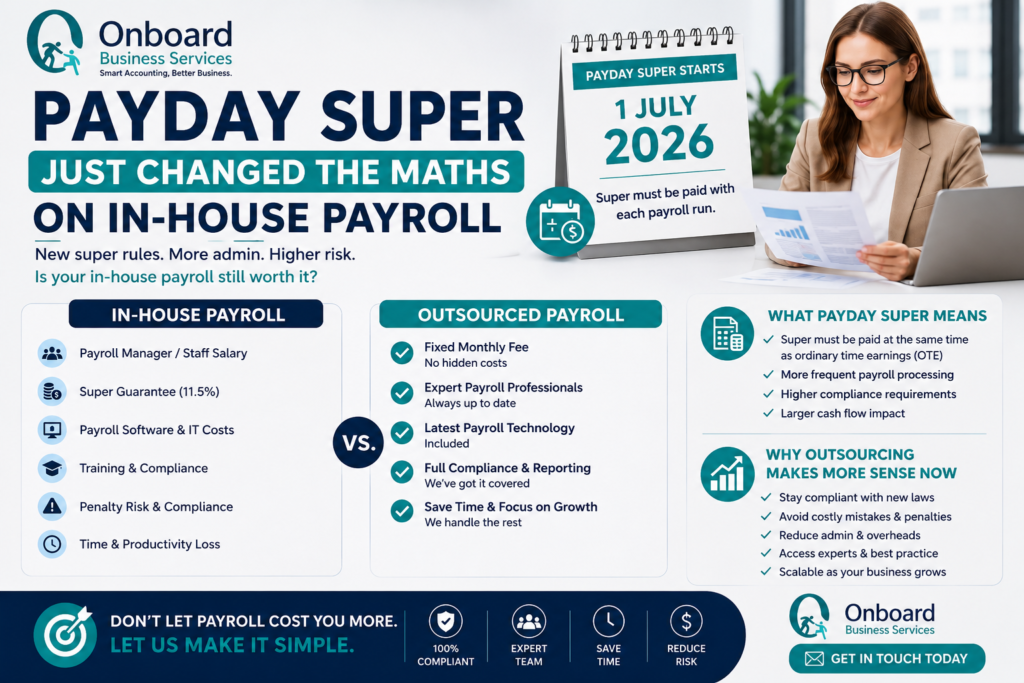
Until this year, employers had 28 days after the end of each quarter to get super into an employee’s fund. From 1 July 2026, that window has effectively disappeared: super guarantee payments now need to be received by the employee’s fund within seven business days of payday — every payday, not once a quarter.
A few details matter here:
- The Small Business Superannuation Clearing House closed to all users on 1 July 2026, so any business still relying on it needs an alternative already in place.
- If a payment is late, the super guarantee charge (SGC) is now assessed automatically by the ATO rather than self-reported, includes daily compounding interest, and carries a 25% or 50% penalty depending on prior compliance history.
- On the upside, the SGC is now tax deductible when it applies — it wasn’t before.
For a business running payroll through spreadsheets or a part-time bookkeeper who comes in monthly, a seven-day, every-payday cycle is a different operating rhythm entirely. That’s pushed a lot of businesses to either invest in properly integrated payroll software or hand the whole function to a team that’s already built for it.
AML/CTF Tranche 2 Adds a New Layer for Accounting Practices
The same day, Australia’s AML/CTF regime expanded to cover accountants, bookkeepers, tax agents, and several other professions for the first time — commonly called Tranche 2. It’s more targeted than headlines suggest: the obligation attaches to specific designated services, such as assisting with company or trust formation or managing client money as part of a broader service. Routine bookkeeping, standard tax return preparation, and general BAS work aren’t designated services on their own and don’t automatically trigger the regime.
For practices that are in scope, the obligations are substantial: enrolling with AUSTRAC, standing up a written AML/CTF program, running customer due diligence on clients, training staff, and keeping records for seven years. AUSTRAC opened enrolment on 31 March 2026, and firms already providing designated services need to be enrolled by 29 July 2026.
The practical effect for a lot of practices: the partners and senior staff who’d normally split their time between advisory work and routine compliance now need to ringfence real hours for AML/CTF setup. Something has to give, and for many firms, that something is the production-line bookkeeping and BAS work that doesn’t need a partner’s attention in the first place.
The Accounting Talent Shortage Hasn’t Eased
None of this is landing on a well-staffed sector. Recruitment in Australian accounting has been tight for years, and industry turnover research has put annual staff turnover at accounting and professional services firms in the 13–15% range — high enough that many practices are in a near-constant hiring cycle just to stay level, let alone grow.
Outsourcing sidesteps the recruitment problem directly. Instead of a months-long search for an experienced bookkeeper or BAS-registered staff member, a practice or business gets access to an already-trained team, typically within days rather than months.
The Real Cost of an In-House Hire vs. Outsourcing

The average bookkeeper salary in Australia in 2026 sits around $65,000 to $75,000, with senior or BAS-registered staff commanding more. That’s the number most owners budget against — but it’s rarely the full cost. Superannuation, leave entitlements, payroll tax, software licences, equipment, and the time a manager spends supervising and covering for absences all sit on top of the base salary.
Outsourced arrangements are typically structured differently — pricing scales with transaction volume or scope of work rather than a fixed headcount cost, and backup coverage for leave or turnover is generally built into the service rather than something you have to plan for separately. That doesn’t automatically make outsourcing cheaper in every case; it depends heavily on your transaction volume and complexity. But for businesses whose bookkeeping needs are steady rather than large enough to justify a full-time specialist, the maths increasingly favours outsourcing.
Why Practices Are Outsourcing Their Own Back Office
Outsourcing isn’t only a small-business decision anymore. A growing number of Australian accounting and bookkeeping practices are outsourcing their own production work — bookkeeping, payroll processing, tax return preparation, SMSF administration — to specialist outsourced teams, so their in-house accountants can spend more time on advisory work and client relationships instead of data entry and reconciliations.
This is a different trend from an SME outsourcing its books directly. It’s practice-to-provider outsourcing, and it lets a firm scale its delivery capacity for busy periods (like BAS season or EOFY) without matching every increase in client load with a new full-time hire. Given the AML/CTF and Payday Super pressures above, it’s also becoming a way to free up the senior staff time that new compliance obligations now demand.
What to Look for in an Outsourced Accounting Partner
- Registered agent status. For BAS and tax lodgment work, the provider should be a registered BAS or tax agent, or operate under the direct supervision of one — unregistered agents offer no protection if something goes wrong.
- Data security practices. Ask specifically how client data is stored and accessed, and how that aligns with the Privacy Act 1988 (Cth) and the Australian Privacy Principles.
- Software fluency. Genuine, demonstrated experience in Xero, MYOB, or QuickBooks — not just familiarity, but the ability to manage integrations, bank feeds, and reporting.
- Clear service level agreements. Turnaround times, escalation paths, and what happens when volume spikes should all be spelled out before you start, not figured out after.
- Australian-specific compliance knowledge. If the team is offshore, their familiarity with BAS, PAYG, and superannuation rules — not just general bookkeeping — is what separates a genuinely useful partner from a generic data-entry service.
Common Concerns About Outsourcing — and What Usually Addresses Them
- “What about data security?” Reputable providers work on compliant cloud platforms (Xero, MYOB) with defined access controls, rather than emailing spreadsheets back and forth.
- “Will communication be harder?” Structured handover processes and defined overlap hours generally solve this better than hoping time zones align by chance.
- “Will I lose control?” A clear service level agreement with named points of contact and regular reporting keeps visibility high — arguably higher than an in-house hire nobody’s actively supervising day to day.
- “How do I know they’re legitimate?” Ask for their registered agent number, request references from current Australian clients, and start with a defined trial scope before handing over everything.
Related Articles (Internal Linking)
- BAS Lodgment Deadlines 2026: A Guide for Australian Small Businesses — Every quarterly, monthly and annual BAS due date for the current financial year.
External Authority Suggestions
- ATO — About Payday Super (ato.gov.au)
- ATO — Missed or late Payday Super payments (ato.gov.au)
- AUSTRAC — Accountants industry guidance on Tranche 2 (austrac.gov.au)
- Tax Practitioners Board — Find a registered BAS or tax agent (tpb.gov.au)
- Fair Work Ombudsman — Payday Super: new rules starting 1 July 2026 (fairwork.gov.au)