
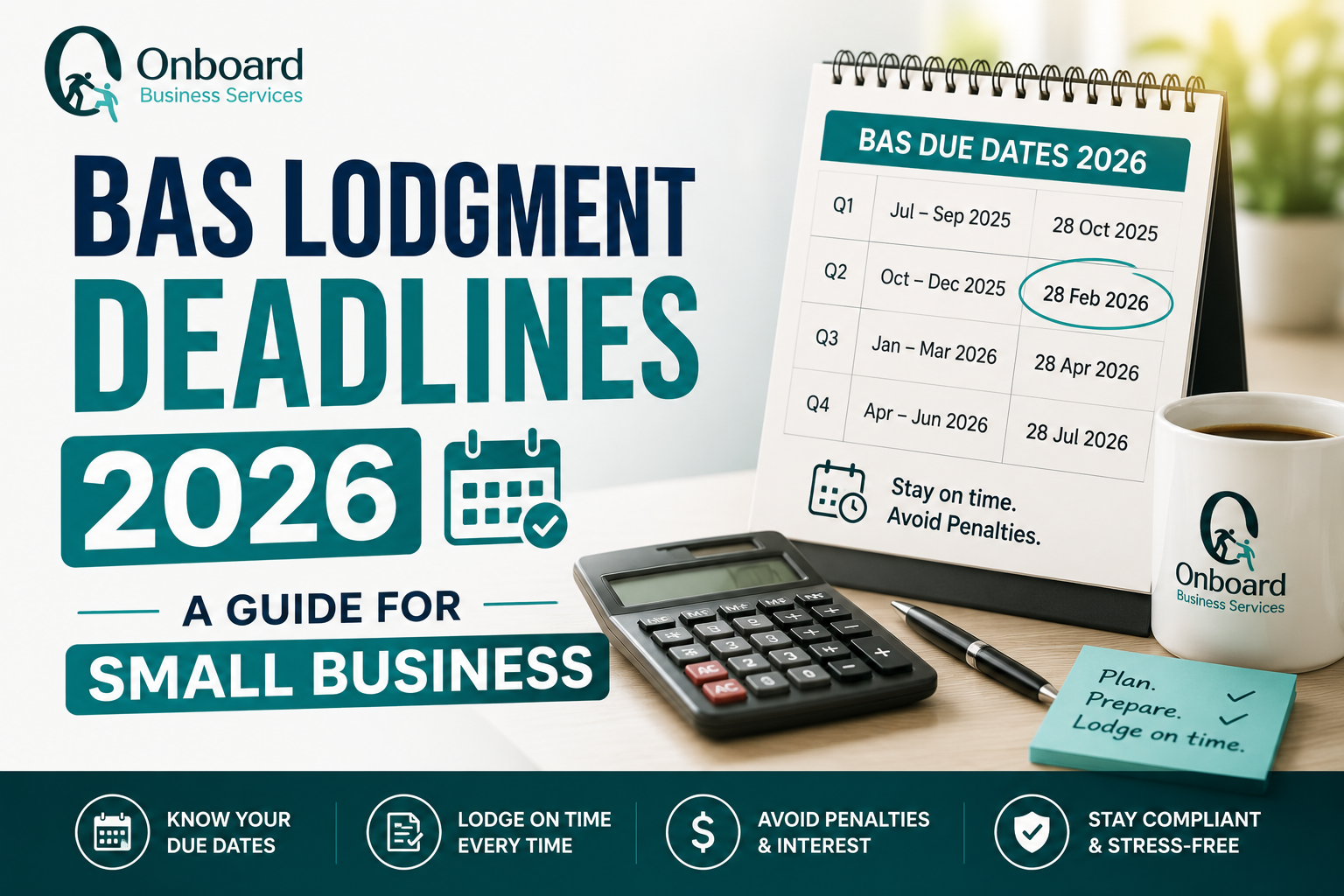
BAS Lodgment Deadlines 2026: Important Dates Every Business Owner Should Know
BAS Lodgment Deadlines 2026: The Complete Guide for Australian Small Businesses
Missing a BAS deadline is one of the easiest ways to lose money you never needed to spend. The failure-to-lodge penalty starts accruing the moment you’re late, and it keeps compounding every 28 days whether or not you actually owe any GST. The good news: BAS due dates don’t move around much, and once you’ve got them mapped out for the year, staying compliant is mostly a matter of habit.
This guide covers every BAS lodgment deadline for the 2025–26 financial year — quarterly, monthly, and annual — plus what happens if you miss one, and how to make sure you don’t.
This article provides general information only. Confirm current rates and dates with the ATO or your registered tax agent before relying on them for your own lodgment.
Your BAS Due Dates at a Glance (2025–26)
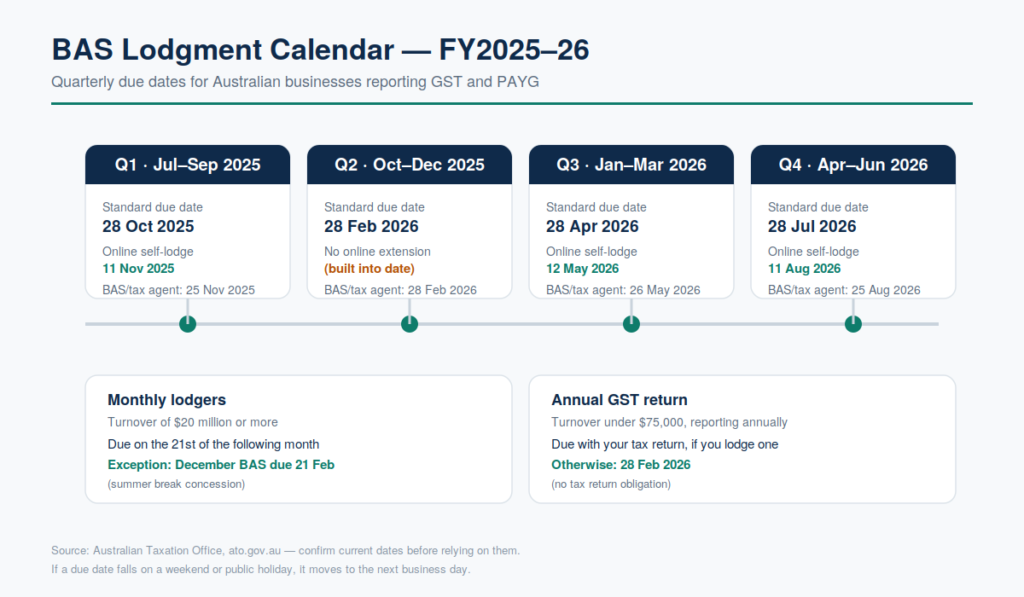
| Quarter | Period Covered | Standard Due Date | Online Self-Lodge | Registered Agent |
|---|---|---|---|---|
| Q1 | Jul–Sep 2025 | 28 Oct 2025 | 11 Nov 2025 | 25 Nov 2025 |
| Q2 | Oct–Dec 2025 | 28 Feb 2026 | No extension | 28 Feb 2026 |
| Q3 | Jan–Mar 2026 | 28 Apr 2026 | 12 May 2026 | 26 May 2026 |
| Q4 | Apr–Jun 2026 | 28 Jul 2026 | 11 Aug 2026 | 25 Aug 2026 |
If a due date falls on a weekend or public holiday, it automatically shifts to the next business day.
Quarterly BAS: The Standard Cycle for Most Businesses
If your GST turnover is under $20 million, you’ll almost certainly be on the quarterly cycle. Each BAS is due 28 days after the quarter ends — except the December quarter, which gets pushed out to the end of February to account for the Christmas and New Year break.
There are two ways to get extra time on top of the standard due date:
- Lodge online yourself. Submitting through myGov, ATO Online Services, or SBR-enabled software gets you an automatic two-week extension on the standard due date. This doesn’t apply to the December quarter (which already has its extension built in), and it doesn’t apply to monthly or annual lodgers.
- Use a registered BAS or tax agent. Agents on the ATO’s lodgment program get concession dates that go even further — provided you’re on their client list before the original due date passes, and your previous BAS was lodged electronically.
Worth noting: the agent concession only kicks in if you were already engaged with that agent before the standard due date. Signing up the week your BAS is due won’t retroactively unlock the concession.
Monthly BAS: Turnover of $20 Million or More
Businesses with a GST turnover of $20 million or more must lodge monthly rather than quarterly. Monthly BAS is due on the 21st of the following month, with one exception: the December monthly BAS is due 21 February, not 21 January, giving businesses the same summer breathing room that quarterly lodgers get.
Annual GST Return: The Once-a-Year Option
If your GST turnover is under $75,000 and you’ve elected to report annually, or you’re a GST instalment payer, you may only need to lodge once a year. The due date depends on your situation:
- If you have a tax return lodgment obligation, your annual GST return is due at the same time as your tax return.
- If you don’t have a tax return obligation, it’s due by 28 February 2026.
This option suits very small operations with simple GST affairs, but it’s worth discussing with your accountant — quarterly reporting gives you more regular visibility into your GST position and reduces the size of any single bill.
What Happens If You Miss a BAS Deadline
Two separate penalties can apply, and they stack — you can be hit with both at once.
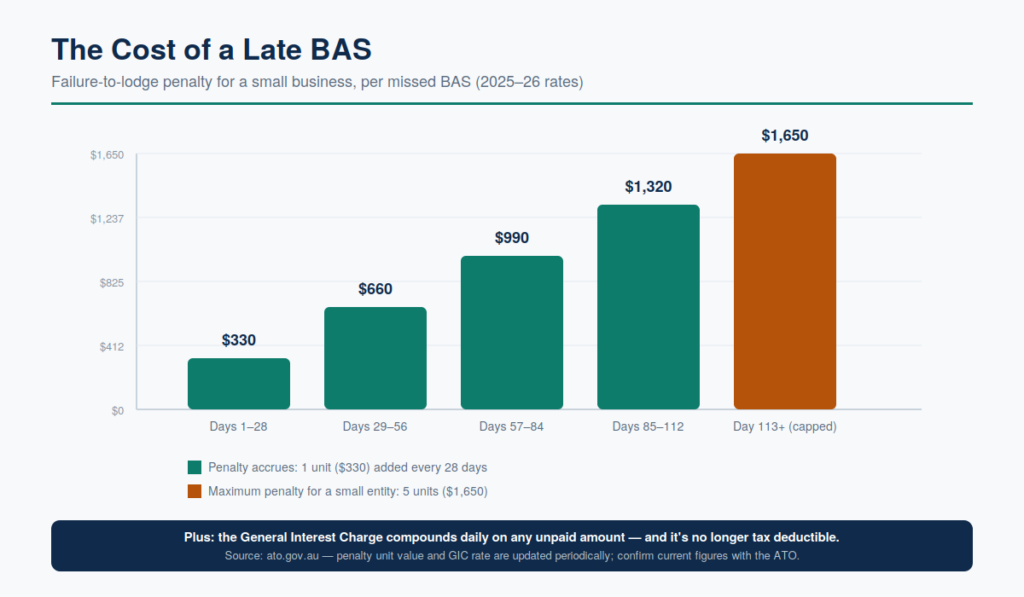
Failure to lodge (FTL) penalty. This is calculated in penalty units — one unit for every 28-day period (or part of one) that your BAS is overdue, capped at five units. From 1 July 2025, one penalty unit is worth $330, which means a small entity’s maximum FTL penalty is $1,650. Larger entities face higher multipliers, so this scale applies specifically to small businesses.
This penalty applies per lodgment. Miss all four quarterly BAS statements in a year and you could be looking at $6,600 in penalties alone — even if every one of those BAS would have resulted in a nil balance or a refund.
General interest charge (GIC). If you lodge on time but don’t pay by the due date, GIC accrues daily on the unpaid amount, compounding. The rate is reset quarterly and tied to the RBA’s 90-day bank bill rate plus a set uplift, so it moves — check the ATO website for the current rate before estimating what you’d owe. One change worth flagging: from 1 July 2025, GIC is no longer tax deductible. Previously you could claim a deduction that softened the real cost by roughly a quarter to a third. Now the full amount comes straight out of after-tax dollars, which makes paying on time meaningfully more valuable than it used to be.
External Authority Suggestions
- ATO — Due dates for lodging and paying your BAS (ato.gov.au)
- ATO — Registered agent lodgment program 2025–26 (ato.gov.au)
- ATO — General Interest Charge (GIC) rates (ato.gov.au)
- Tax Practitioners Board — Find a registered BAS or tax agent (tpb.gov.au)
- ATO — Registering for GST (ato.gov.au)